Certainly! Below is a detailed professional blog article expanding on the topic of Graphite Rotors and Graphite Wheels, incorporating the requested keywords in a meaningful context where relevant.
---
# Exploring the Innovations and Applications of Graphite Rotors and Graphite Wheels
In the realm of advanced materials engineering and industrial applications, graphite-based components have carved a niche for their remarkable properties. Among these, **Graphite Rotors** and **Graphite Wheels** stand out as innovative solutions utilized across various industries—from automotive to aerospace, manufacturing, and beyond. This article delves into the technology behind graphite rotors and wheels, their advantages, applications, and the design considerations that make them invaluable in modern engineering.
## Understanding Graphite: The Material Foundation
Graphite’s unique structure—a hexagonal lattice of carbon atoms arranged in layers—imparts it with exceptional properties such as high thermal conductivity, excellent lubrication, chemical inertness, and outstanding mechanical strength under specific conditions. Unlike metals, graphite can withstand extreme temperatures without melting, making it ideal for high-performance rotating components like rotors and wheels.
### Key Material Properties:
- **Thermal Stability:** Maintains integrity at high temperatures.
- **Low Friction Coefficient:** Acts as a natural lubricant.
- **Lightweight:** Lower density than many metals, contributing to reduced system mass.
- **Corrosion Resistance:** Impervious to many chemicals and oxidizing environments.
These properties form the backbone of why graphite is preferred in critical rotating machinery components.
## What Are Graphite Rotors and Graphite Wheels?
### Graphite Rotors
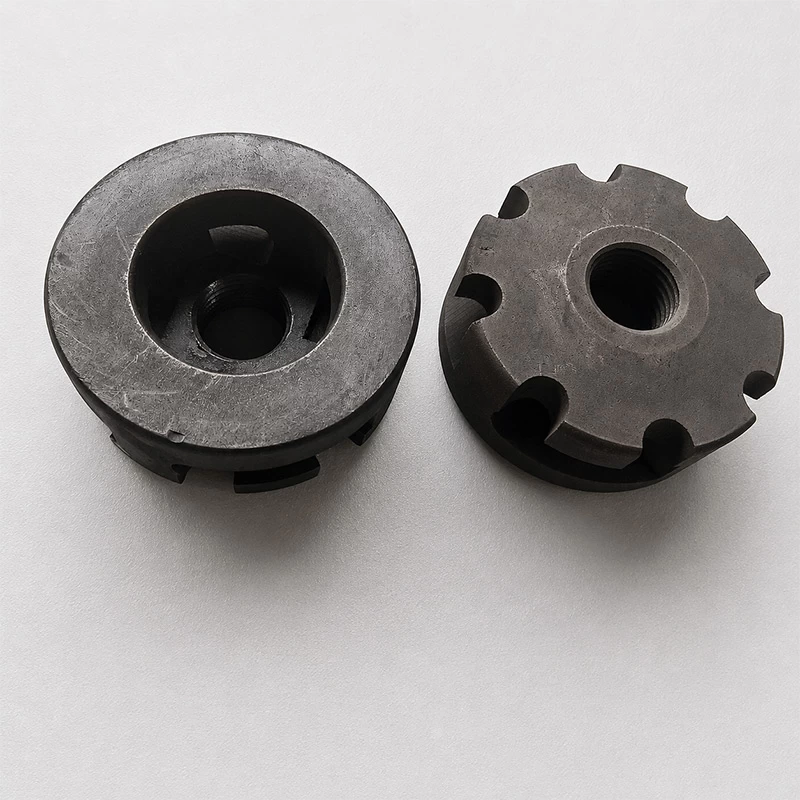
A rotor is a rotating part of a machine, commonly found in motors, pumps, compressors, and braking systems. A **graphite rotor** is specifically engineered using graphite or graphite composites to leverage its thermal and mechanical advantages.
Graphite rotors are often employed in electromagnetic braking systems, vacuum pumps, and certain types of turbines where heat dissipation and wear resistance are critical. Their design involves precise control over dimensions—such as width, max-width, and border-radius—to optimize performance and durability.
### Graphite Wheels
Graphite wheels are grinding wheels or cutting wheels made from graphite composites or integrated with graphite elements. Their low friction and thermal conductivity allow for efficient material removal with minimal heat buildup and longer tool life.
They are widely used in machining applications, especially where precision and surface finish are critical. The ability to maintain structural integrity under high-speed rotation and thermal stress makes graphite wheels indispensable in high-end manufacturing.
## Advantages of Graphite Rotors and Wheels
When comparing graphite components to traditional metallic counterparts, several advantages come to the fore:
### 1. Superior Thermal Management
Graphite’s high thermal conductivity facilitates rapid heat dissipation during operation, preventing overheating—a common cause of failure in rotating components. This property reduces thermal expansion and distortion, maintaining tight tolerances essential for rotor balance and wheel precision.
### 2. Reduced Wear and Maintenance
Thanks to graphite's inherent lubricating qualities, components such as graphite rotors and wheels experience less wear and friction during operation. This translates to extended service intervals and reduced downtime, which is particularly beneficial in industrial environments relying on continuous operation.
### 3. Lightweight Design
Graphite’s lower density compared to steel or aluminum enables the production of lighter rotors and wheels. This weight reduction improves overall system efficiency, reduces inertia (beneficial in braking systems), and lowers energy consumption in rotating machinery.
### 4. Chemical Resistance
Graphite’s inert nature allows it to operate in harsh chemical environments without degradation. This quality makes graphite rotors and wheels suitable for use in chemical processing plants, corrosive atmospheres, and specialized aerospace applications.
## Engineering Considerations in Design
The design of graphite rotors and wheels involves careful consideration of multiple factors, many of which parallel principles found in CSS layout design when creating responsive, adaptive structures—though here applied physically rather than digitally.
### Margin and Padding Analogy: Mechanical Clearances and Tolerances
Just as CSS uses margin and padding to create space around and inside elements, mechanical engineers must define **clearances and tolerances** around graphite components to accommodate thermal expansion and prevent interference during rotation. Proper spacing prevents contact with housing or adjacent parts, avoiding damage and ensuring smooth operation.
### Box-Sizing Equivalent: Dimensional Stability
In web design, the `box-sizing` property controls how width and height are calculated including padding and borders. Similarly, in graphite rotor/wheel design, understanding how the component’s dimensions change due to temperature and mechanical stress is crucial. This ensures the final assembly fits correctly and functions reliably.
### Font-Family and Typography vs. Material Composition
Just as `font-family` defines the style and readability of text, the choice of graphite grade and composite matrix determines the mechanical “style” and performance characteristics of rotors and wheels. Different grades offer varying degrees of hardness, porosity, and strength, tailored to the specific application.
### Background and Color: Surface Treatments and Coatings
While CSS employs `background` and `color` for aesthetics, in graphite components, surface treatments serve functional purposes. Coatings may be applied to enhance wear resistance, reduce oxidation, or improve thermal emissivity—akin to applying a linear-gradient for visual effect in CSS but targeted here for performance enhancement.
### Width and Max-Width: Dimensional Constraints
Designing rotors and wheels includes defining strict dimensional constraints (e.g., width, max-width) to ensure compatibility with existing machinery and to meet performance criteria such as rotational speed limits and load capacity.
### Border-Radius: Edge Profiling and Stress Reduction
Just as `border-radius` softens corners in CSS to improve aesthetics and usability, edge profiling in graphite rotors and wheels reduces stress concentration points, preventing cracks and improving fatigue life.
### Position, Overflow, and Z-Index: Assembly and Layering
Positioning components within assemblies requires attention similar to CSS layout properties like `position`, `overflow`, and `z-index`. Graphite parts must be securely positioned to avoid unwanted movement or stress, and layered composites require precise stacking order to maximize strength.
### Display: Grid and Flex Analogies in Structural Design
Modern CSS layouts use `display: grid` or `flex` to organize content efficiently. Similarly, the internal microstructure of graphite composites can be engineered in grid-like or layered “flexible” configurations to optimize mechanical properties such as toughness and shock absorption.
### Grid-Template-Columns and Gap: Composite Layering and Porosity Control
In CSS, `grid-template-columns` and `gap` define column structure and spacing. In graphite wheels, controlling the layering and spacing of fibers or filler materials influences porosity and permeability, directly impacting performance characteristics like cooling and durability.
### Align-Items, Letter-Spacing, and Text-Transform: Structural Alignment and Finishing
Aligning fibers in graphite composites is akin to using `align-items` in flexbox. Proper alignment enhances strength along desired load paths. Finishing processes affect surface texture, much like `letter-spacing` affects text readability and `text-transform` modifies case—both altering the final output appearance and function.
### Font-Size, Line-Height, and Font: Scale and Proportions
Scaling graphite components while maintaining proportions is critical, comparable to setting `font-size` and `line-height` in typography for readability and aesthetics. The right scale ensures optimal performance without excess weight or risk of failure.
## Applications Across Industries
### Automotive and Aerospace
Graphite rotors are increasingly used in high-performance braking systems due to their outstanding thermal management and lightweight attributes. Graphite wheels in aerospace manufacturing enable precision grinding of turbine blades, improving engine efficiency.
### Manufacturing and Machining
Graphite grinding wheels offer superior cutting efficiency and longer life, especially when machining hard metals and ceramics. Their ability to dissipate heat reduces thermal damage to workpieces, enhancing product quality.
### Energy Sector
In turbines, pumps, and compressors, graphite rotors withstand harsh conditions, including high temperatures and corrosive fluids, prolonging equipment life and reducing maintenance costs.
## Future Trends and Developments
Research into graphite composites continues to push boundaries, focusing on:
- **Nanostructured Graphite Materials:** Enhancing strength and conductivity.
- **Hybrid Composites:** Combining graphite with polymers or ceramics for tailored properties.
- **Additive Manufacturing:** Enabling complex rotor and wheel geometries previously impossible with traditional methods.
- **Surface Engineering:** Developing advanced coatings to further extend lifespan and performance.
## Conclusion
Graphite rotors and graphite wheels represent a fusion of material science ingenuity and advanced engineering design. Their unique properties address longstanding challenges in heat management, wear resistance, and weight reduction across multiple industries. By carefully considering design parameters analogous to CSS layout properties—spacing, sizing, alignment, layering—engineers optimize these components for maximum efficiency and reliability.
As industry demands evolve, continuing innovation in graphite materials and manufacturing techniques promises even greater performance gains, solidifying graphite rotors and wheels as cornerstone components in the future of high-tech machinery and manufacturing.
---
**Keywords:** margin, padding, box-sizing, font-family, background, color, width, max-width, border-radius, position, overflow, linear-gradient, content (pseudo-element), z-index, display (grid, flex, inline-flex), grid-template-columns, gap, align-items (center, flex-start), letter-spacing, text-transform (uppercase), font-size, line-height, font
---
If you'd like, I can also provide detailed technical specifications or case studies related to graphite rotors and wheels.